
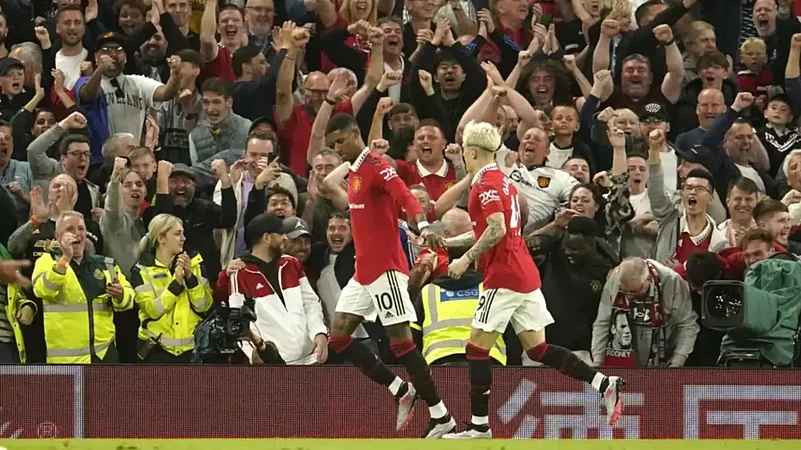
Manchester United’s 2-1 victory over Chelsea at Old Trafford in September 2025 looked, on the surface, like a hard-fought early-season home win, but the way it unfolded under pressure turned it into a psychological hinge for their entire campaign. From an early red card and a 2-0 lead to a second-half siege and a nervy finale, the match forced United to solve problems in real time, revealing how one chaotic evening can reset belief, tactics and expectations for the months ahead.
Why this fixture carried more weight than the table suggested
Even though this was only United’s second league win of the season, the context made it far more consequential than a routine three points. United came into the game on the back of an uneven start and a heavy 3-0 defeat at Manchester City, which had intensified doubts about Ruben Amorim’s ability to impose his ideas quickly and stabilise results. Chelsea, by contrast, arrived unbeaten in the league and fresh from a strong start under Enzo Maresca, so beating them did not simply add points; it directly challenged the emerging narrative that United were drifting while others were accelerating.
How early chaos created the conditions for a turning point
The match became unpredictable within minutes, and that early chaos set up the psychological landscape for what followed. In only the fifth minute, Chelsea goalkeeper Robert Sánchez was sent off for a reckless foul on Bryan Mbeumo outside the box, forcing Maresca into immediate substitutions and reshaping his entire game plan around damage limitation. United then capitalised on the numerical advantage, with Bruno Fernandes scoring his 100th goal for the club on his 200th Premier League appearance before Casemiro added a close-range header, creating a 2-0 lead that appeared to resolve the contest early but actually raised a new question: could this vulnerable United side manage a game they were expected to control?
The tactical shifts that defined United’s response
United’s response to the evolving game state showed why this match offered more than just a confidence boost; it tested the adaptability of Amorim’s model under stress. After Casemiro’s second yellow card in first-half stoppage time levelled the numbers and removed a key defensive presence, United had to abandon their initial attacking balance and adjust to a more compact, survival-oriented structure for the second half. Amorim’s decision to introduce Manuel Ugarte at the break and later turn to defensive reinforcements like Harry Maguire demonstrated a deliberate shift from proactive pressing to preserving central stability, which allowed United to absorb Chelsea’s late pressure without completely collapsing their midfield shape.
Mechanisms of control under numerical and emotional strain
The crucial mechanism in United’s second-half performance was how they managed space rather than possession. With the sodden Old Trafford surface disrupting fluent passing for both sides, United focused on compressing the central channels, keeping distances between defenders and midfielders tight so that Chelsea’s attempts to play through could be funnelled into wide, less dangerous areas. This approach reduced the number of clear shooting opportunities Chelsea could generate despite their territorial push, meaning that even when Trevoh Chalobah’s 80th-minute header halved the deficit, United still had enough structural integrity to survive seven minutes of stoppage time without conceding the kind of clean chance that typically punishes a nervous home side.
Why Casemiro’s red card changed the meaning of the win
Casemiro’s dismissal did more than change the numbers on the pitch; it altered the emotional difficulty of the challenge United had to solve. His first-half header to make it 2-0 looked like a classic “big game player” moment, but the second yellow card in the 45+5th minute turned him into both hero and liability, forcing United to prove they could protect a lead without one of their most experienced figures. The fact that they withstood Chelsea’s late surge after losing Casemiro reframed the performance from one built purely on individual quality to one rooted in collective resilience and tactical discipline, a shift that matters for how a squad sees itself in future high-pressure situations.
How the late stages at Old Trafford rewrote United’s psychological script
The final 20 minutes, with Chelsea pushing for an equaliser in torrential rain, turned the match from comfortable into defining. Chalobah’s 80th-minute goal transformed what had seemed a controlled evening into a test of nerve, as United suddenly had to defend deep against a Chelsea side sensing a comeback, with the crowd living every clearance and block. Navigating that period without conceding again allowed United to bank a specific type of experience: knowing they can protect a fragile lead with ten men, under intense pressure, against a high-level opponent—evidence that becomes a reference point the next time similar stress appears late in a game.
To see why this matters across a season, it helps to set this game alongside United’s immediate past in the league.
| Match | Key event pattern | Psychological outcome for United |
| Man City 3-0 Man United | Early goals conceded, little route back | Reinforced doubts about resilience and structure |
| Man United 2-1 Chelsea | Early lead, red card, late siege survived | Provided proof they can suffer and still win |
By moving from being convincingly beaten by a title contender to outlasting Chelsea in a scrappy, high-anxiety contest, United subtly transitioned from a team that “collapses under pressure” to one that has at least one concrete example of holding firm when the game turns against them.
Live-game reading: where this match becomes an educational case
For observers trying to understand how turning points emerge, this match is a useful live-reading case because the swing in difficulty was visible long before the final whistle. Early on, the numerical advantage and 2-0 lead suggested a routine home win, but the tone shifted the moment Casemiro was sent off, when United’s body language, passing choices and defensive line height all changed under the new risk profile. Watching those changes in real time teaches that the underlying performance narrative—who is growing into the game, who is shrinking from it—often diverges from the simple scoreline, especially when cards, conditions and substitutions repeatedly alter the balance.
It is in matches with this kind of volatility that consistent visual observation becomes more valuable than relying solely on statistics or highlight clips, because the tempo shifts, spacing adjustments and subtle dips in confidence often precede the big moments; for anyone trying to refine their live-reading skills across a season, revisiting full games like this through ดูบอลสด goaldaddy makes it easier to pause and re-examine sequences where the emotional tone shifts—from United’s early dominance to the unease after the red card—so that future interpretations of late-game pressure are grounded in specific, replayed examples rather than vague impressions of “momentum.”
Why this result changed the trajectory of United’s season
From a macro perspective, the Chelsea win mattered because it intersected form, narrative and league position at exactly the moment United needed a stabilising event. The three points lifted them into the top half of the table and ended their early-season struggles, but more importantly, it came against an opponent whose unbeaten run and status as Club World Cup holders gave the result added weight in the dressing room and in public discourse. Amorim could now point to a specific match where his players implemented his instructions, adapted to adversity and saw the process rewarded, which gave him firmer ground to demand similar discipline and resilience in subsequent fixtures rather than trying to sell ideas without concrete evidence of success.
Where the “turning point” narrative could still have failed
It is important to recognise that calling this match a season turning point is contingent rather than guaranteed, because football history is full of dramatic wins that do not actually change long-term trajectories. Had United followed this result with another heavy defeat against a direct rival, or repeated the same structural issues that appeared at the Etihad, the psychological boost from outlasting Chelsea would have faded quickly and the game would be remembered as an emotional high point rather than a genuine inflection. What gives the “turning point” label credibility is when the behaviours seen in this match—more compact defending with ten men, better game management in the final minutes, a refusal to panic after setbacks—start to appear consistently in later performances, indicating that the lessons learned in the rain at Old Trafford were actually integrated.
Summary
Manchester United’s 2-1 win over Chelsea in the 2025/26 Premier League season became a turning point not because of the scoreline alone, but because of how many problems had to be solved within one chaotic evening at Old Trafford. From exploiting an early red card to surviving with ten men after Casemiro’s dismissal and enduring a late siege triggered by Chalobah’s header, United converted a fragile lead into a hard-earned statement that they could withstand pressure rather than crumble under it. In a campaign that had already exposed their vulnerabilities against top opposition, this match provided the first concrete evidence that Amorim’s side could adapt, suffer and still emerge with crucial points, giving players and staff a shared reference point that could genuinely reshape the season’s trajectory if the behaviours displayed that night continue to appear in the weeks that follow.
